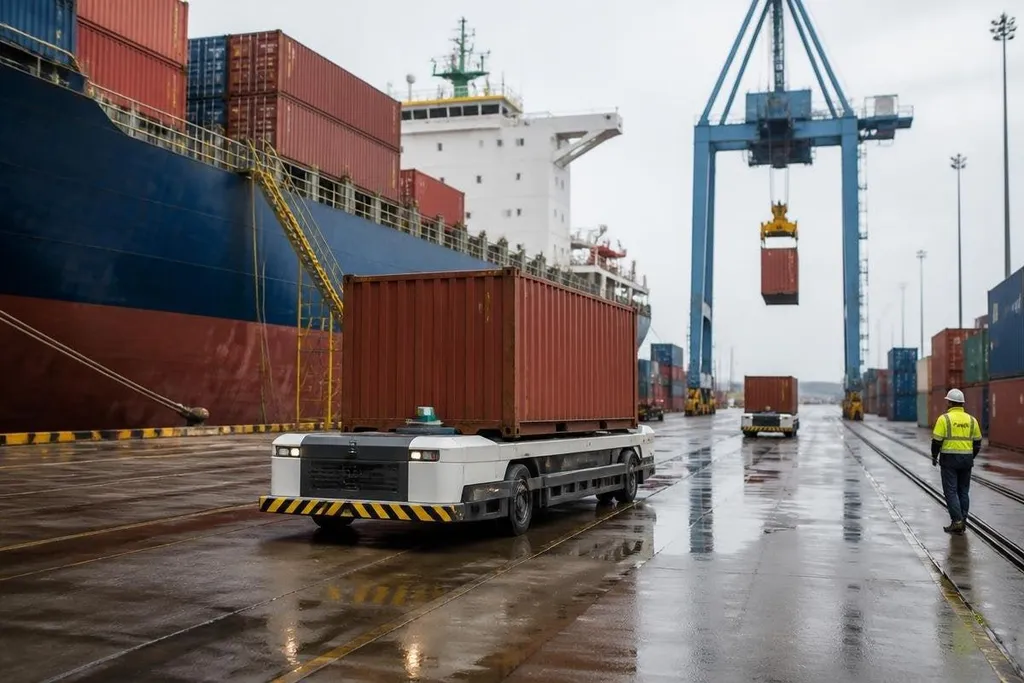
A port robot has to move cargo around ships, trucks, rail lines, and people. A short demo can show motion, but it cannot show whether the system works through a full work period, bad weather, blocked routes, and changing cargo.
The evidence supplied for this topic includes no company names, prices, dates, deployment counts, or test results. That leaves a clear standard for judging port robots: ask what the system does in daily work, then ask for records.
Quick read
- Port robots need clear jobs, such as container movement, inspection, or yard transport.
- Remote control can keep work moving when autonomy meets an unusual case.
- The useful proof is a shift record with stoppages, human interventions, and completed moves.
Start with the job
“Port robot” covers several machines. A yard vehicle may carry containers between a quay and a storage area. An inspection robot may use cameras or LiDAR to check equipment. A robot arm may handle a fixed task near a crane or loading station.
Those jobs need different designs. A transport vehicle needs safe routing, accurate position data, and enough battery for its work period.
An inspection robot needs useful images and a way to send them to a person. A robot arm needs a fixed work area, a known load, and a safe stop when someone enters the zone.
A buyer should reject broad claims until the maker names the task, the load, the route, and the human role. “Autonomous” has little meaning without those details.
The system matters more than the vehicle
A port robot works as part of a larger system. It may use LiDAR to measure nearby objects, cameras to read signs or container markings, and software to plan a route. A remote operator may take control when the robot meets a blocked lane or an object it cannot classify.
That handoff needs its own test. The useful questions are simple: how does the operator know help is needed, how long does the handoff take, and what happens if the network connection drops?
Ports also need clear rules for mixed traffic. Trucks, cranes, maintenance teams, and robots may share the same space. The maker should show how the robot detects people, stops safely, and starts again after the path clears.
A port robot’s safety claim needs more than a stopped demo. Port robotics reports from Robot24.com can put the robot model, test site, traffic mix, and restart result beside the claim before the next section names the records a buyer should ask for.
What counts as proof
A staged demonstration can show that a robot completed one task. A work record shows how often it stopped, how much help it needed, and how much cargo it moved during normal operations.
The record should separate robot work from human work. If an operator guides the robot through every difficult move, the system may still save effort, but its level of autonomy is different from a vehicle that handles the route alone.
No deployment result or independent test is supplied here, so claims about port robots working faster, safer, or at lower cost would go beyond the available evidence. That limit matters for buyers: a polished video cannot set a purchase case on its own.
A practical buying check
Use these points before asking for a pilot:
- Name the task: write down the cargo, route, load, and work period.
- Request the log: ask for completed moves, stops, faults, and operator takeovers.
- Test the handoff: time the change from autonomous control to remote operation.
- Check mixed traffic: run the robot near the people and vehicles it will share space with.
- Set a failure rule: define when the pilot pauses, stops, or needs a manual recovery.
The checklist turns a broad product claim into a test that a port team can repeat. It also gives the maker a fair way to show where the system works and where it still needs a person.
I'd wait for shift records before treating any port robot as ready for a major rollout. The next useful proof will be a dated operating log that shows completed moves, human interventions, and stoppages across normal port work.